Security & Business Continuity
Using Authentik to Secure Your Infrastructure
In modern IT environments, identity has quietly become the most important security boundary in any organisation. Firewalls, network segmentation, and endpoint protection still matter, but the majority of security decisions now revolve around one central question: who is this user, and what should they be allowed to access?
As organisations adopt cloud platforms, SaaS tools, internal web applications, and distributed systems, managing identity becomes increasingly complex. This is where Identity and Access Management (IAM) systems come in, and more specifically, Identity Providers (IdPs) such as Authentik.
This article takes a deep, practical look at what IAM and IdPs are, how they work, and how Authentik can be used to secure modern infrastructure in a business context. We’ll go beyond surface-level explanations and explore how identity systems are actually structured, why they matter, and how they fit into real-world security architecture.
Understanding Identity in Modern Systems
Before diving into IAM and IdPs, it is important to understand what “identity” actually means in computing terms.
An identity is not just a username. In modern systems, an identity is a collection of attributes that describe a user, service, or device. These attributes may include:
- A unique identifier (such as a username or UUID)
- Authentication credentials (passwords, keys, biometrics)
- Group memberships (e.g. Admin, HR, Developer)
- Roles and permissions
- Metadata such as department, location, or device trust level
Identity is what allows systems to move from anonymous access to controlled, accountable interaction. Without identity, every request would be treated the same, which is not viable in any business environment.
The challenge is that modern organisations don’t have just one system they have many. Each system needs to understand identity, which is where problems begin.
What is Identity and Access Management (IAM)?
Identity and Access Management (IAM) refers to the set of processes, policies, and technologies used to manage digital identities and control access to resources.
At its core, IAM answers two fundamental questions:
- Who are you? (Authentication)
- What are you allowed to do? (Authorisation)
These two concepts are closely related but distinct.
Authentication verifies identity. It confirms that a user is who they claim to be, usually through credentials like passwords, multi-factor authentication (MFA), or external identity systems.
Authorisation determines what an authenticated user is permitted to access. This is typically controlled through roles, groups, and policies.
IAM systems exist to unify and enforce both of these processes consistently across an organisation.
Without IAM, each application would need to implement its own authentication and authorisation logic. This leads to duplication, inconsistent security standards, and a much larger attack surface.
With IAM, identity becomes centralised and standardised, allowing security policies to be enforced uniformly.
Why IAM is Critical in Modern Infrastructure
Modern organisations typically use dozens or even hundreds of systems. These may include:
- Internal dashboards
- Cloud platforms such as AWS, Azure, or GCP
- SaaS tools like CRM, HR systems, and collaboration platforms
- Developer tools like CI/CD pipelines and monitoring systems
- Customer-facing applications
Each of these systems requires some form of identity management. Without IAM, each one becomes a separate identity silo.
This creates several major problems.
First, it leads to password sprawl. Users must remember multiple credentials, often leading to weak or reused passwords. This is one of the most common causes of security breaches.
Second, onboarding and offboarding become difficult. When an employee joins or leaves an organisation, administrators must manually create or revoke access across multiple systems. This process is slow and error-prone.
Third, auditing becomes nearly impossible. There is no central view of who has access to what, making compliance and security investigations more difficult.
IAM solves these problems by centralising identity management into a single system.
What is an Identity Provider (IdP)?
An Identity Provider (IdP) is a core component of IAM systems. It is responsible for authenticating users and issuing identity assertions that other systems can trust.
In simpler terms, an IdP is the system that answers: “Who are you?”
When a user logs into an application that uses an IdP, the application does not verify the password itself. Instead, it redirects the user to the IdP. The IdP handles authentication and then returns a secure token that proves the user’s identity.
This token can then be used across multiple applications without needing to log in again. This is the foundation of Single Sign-On (SSO).
How an IdP Works in Practice
A typical authentication flow using an IdP looks like this:
A user attempts to access a protected application. The application does not allow direct access. Instead, it redirects the user to the Identity Provider.
The user then authenticates with the IdP using a method such as a password, multi-factor authentication, or an external login provider.
Once authentication is successful, the IdP generates a secure token containing identity information about the user. This token is cryptographically signed to prevent tampering.
The user is redirected back to the application along with the token. The application validates the token and grants access based on the identity and associated permissions.
Importantly, the application never sees or stores the user’s password. This significantly reduces security risk.
The Relationship Between IAM and IdPs
IAM is the broader discipline, while the IdP is a key component within it.
IAM includes:
- Identity lifecycle management (creation, updates, deletion)
- Authentication systems (handled by IdPs)
- Authorisation systems (roles, policies, permissions)
- Access governance (auditing, compliance, reporting)
The IdP specifically focuses on authentication and identity assertion.
In practice, modern IAM platforms often include IdP functionality as part of a larger system. This is where solutions like Authentik come into play.
Introducing Authentik in the IAM Landscape
Authentik is an open-source identity provider and access management platform designed to handle modern authentication requirements in a flexible and extensible way.
Unlike traditional enterprise identity systems that are often rigid and expensive, Authentik is designed to be adaptable. It can be deployed in a wide range of environments and supports both modern cloud-native architectures and traditional infrastructure.
At its core, it functions as both an IdP and an IAM platform. This means it handles authentication, issues identity tokens, enforces access policies, and integrates with external systems.
One of its key strengths is that it supports industry-standard protocols such as OpenID Connect, OAuth 2.0, SAML, and LDAP. This ensures compatibility with a wide range of applications and services.
Authentik as a Central Identity Layer
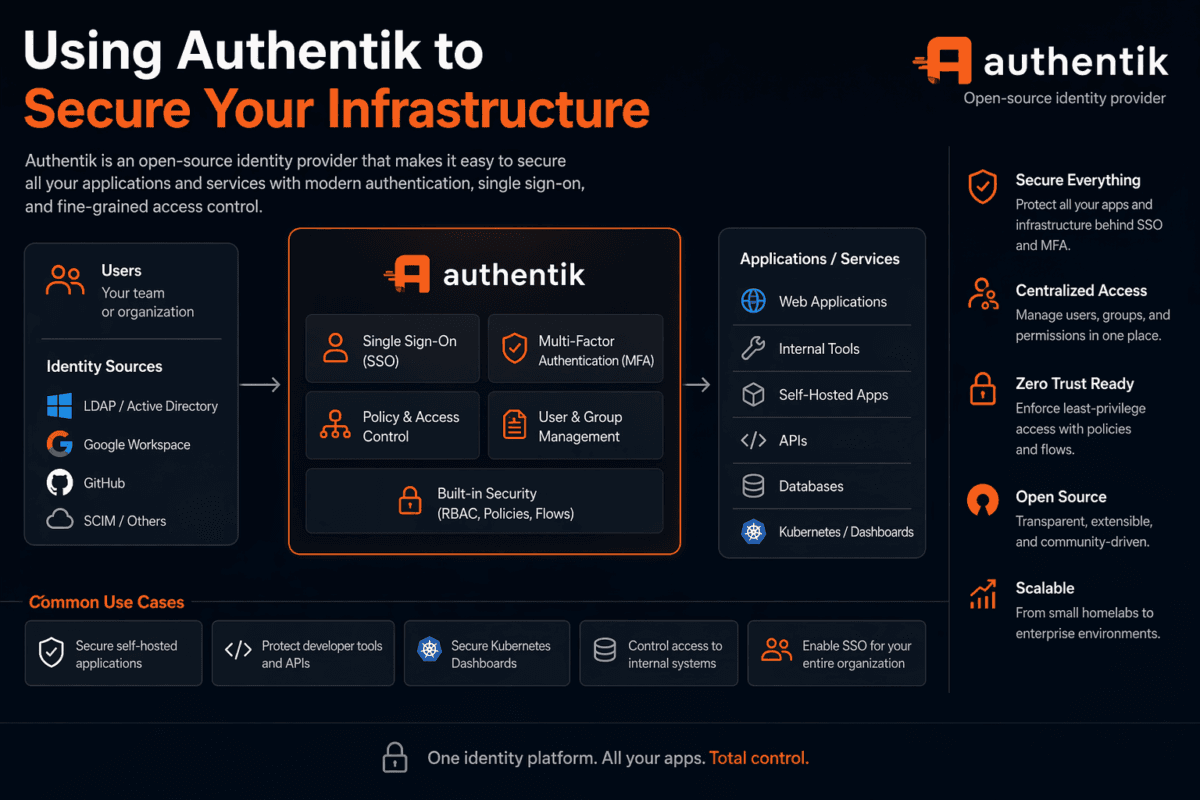
In a typical deployment, Authentik sits between users and applications as a central identity layer.
Instead of each application managing its own users, all authentication requests are delegated to Authentik. This creates a single point of identity control across the entire infrastructure.
This architecture has several important implications.
First, identity becomes consistent across all systems. A user has one identity, not many fragmented accounts.
Second, security policies can be enforced centrally. Instead of configuring MFA or access rules in multiple places, they are defined once in Authentik.
Third, applications become simpler. They no longer need to implement authentication logic, password storage, or session management.
This separation of concerns is a key principle in secure system design.
Authentication and Authorisation in Authentik
Authentication in Authentik is highly flexible. Users can authenticate using traditional username and password combinations, but also through more advanced methods such as time-based one-time passwords (TOTP), hardware security keys, or external identity providers like Google or Microsoft Entra ID.
This flexibility allows organisations to adopt stronger authentication methods without forcing users into a single rigid system.
Once authentication is complete, Authentik issues tokens that represent the user’s identity. These tokens are used by applications to verify access.
Authorisation is handled through policies. These policies define what users can access based on attributes such as group membership, role assignment, or contextual factors.
For example, a developer might be allowed to access staging environments but not production systems. Similarly, access to sensitive dashboards might be restricted to users connecting from a corporate network or using a compliant device.
This combination of authentication and policy-driven authorisation makes Authentik highly suitable for modern security models.
Security Advantages of Centralised Identity
One of the most significant benefits of using a platform like Authentik is the improvement in overall security posture.
By centralising authentication, organisations reduce the number of systems that handle sensitive credentials. This immediately reduces exposure risk.
Single Sign-On (SSO) also improves security by reducing password reuse. Users no longer need to maintain multiple credentials, which means fewer weak passwords in circulation.
Multi-factor authentication becomes easier to enforce consistently. Instead of relying on individual applications to implement MFA, it is enforced at the identity layer.
Another major advantage is improved incident response. If a user account is compromised, access can be revoked centrally and immediately across all connected systems.
Finally, auditing becomes significantly more robust. Every authentication event, policy decision, and access request can be logged in one place, providing a clear trail for compliance and investigation.
Business Use Cases for Authentik
In real-world organisations, Authentik can be applied in several different ways depending on the structure and needs of the business.
For internal IT environments, it often becomes the central gateway to all internal tools. Employees authenticate once and gain access to dashboards, administrative tools, and monitoring systems based on their roles.
For SaaS companies, Authentik can act as the backbone of customer identity management. It supports both consumer logins and enterprise SSO, making it suitable for multi-tenant applications that serve different types of customers.
In engineering environments, it is commonly used to secure access to infrastructure tools such as Kubernetes dashboards, CI/CD systems, and observability platforms. These systems are often highly sensitive and require strict access control.
In larger organisations, Authentik can also be integrated into a Zero Trust architecture. In this model, no user or device is trusted by default. Every access request is evaluated dynamically based on identity, context, and policy.
Deployment Considerations and Operational Reality
While Authentik is powerful, deploying it effectively requires careful planning.
Identity structures such as groups, roles, and permissions must be designed thoughtfully. Poorly designed identity models can become difficult to manage as organisations scale.
Operationally, self-hosting Authentik means the organisation is responsible for uptime, updates, backups, and monitoring. While this provides full control and avoids vendor lock-in, it also introduces operational responsibility.
Integration is generally straightforward thanks to support for standard protocols, but each connected application still requires configuration to trust Authentik as an identity provider.
Despite these considerations, many organisations find that the long-term benefits outweigh the initial setup complexity.
Final Thoughts
Identity is now one of the most critical components of modern cybersecurity architecture. As systems become more distributed and cloud-dependent, managing identity consistently becomes essential.
Identity and Access Management provides the framework for this, and Identity Providers serve as the enforcement point for authentication and identity assertions.
Authentik offers a modern, flexible, and open-source approach to solving these challenges. It enables organisations to centralise identity, enforce strong security policies, and simplify access across complex infrastructures.
For businesses in the UK and beyond, particularly those embracing cloud-native architectures or open-source tooling, Authentik represents a powerful alternative to traditional enterprise identity systems. It brings together security, flexibility, and control in a way that aligns well with modern DevOps and Zero Trust principles.
When implemented correctly, it does more than just manage logins—it becomes a foundational layer of organisational security.
