Business IT Advice
How Much Server Performance Does a Small Business Really Need?
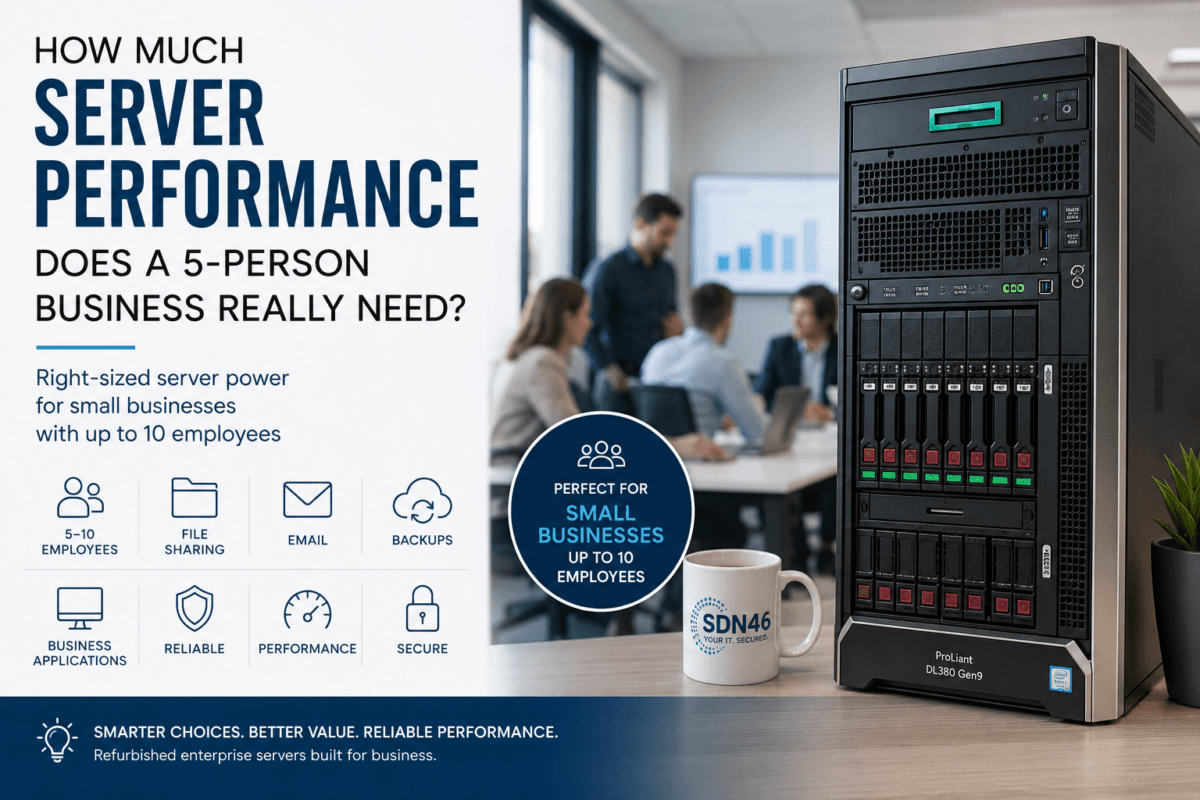
When people think about buying a new server, it’s easy to assume they need the fastest processors, the newest hardware and huge amounts of memory.
After all, every manufacturer advertises incredible performance figures and talks about artificial intelligence, machine learning, hundreds of virtual machines and thousands of simultaneous users.
But if your business has five or ten employees, do you really need any of that?
The answer is almost certainly no.
In reality, most small businesses use only a tiny fraction of the computing power available in modern enterprise servers. Spending thousands of pounds on the latest hardware often provides little real-world benefit and can tie up valuable cash that could be invested elsewhere.
Let’s take a realistic look at what a typical small business actually needs.
What Does a Small Business Server Actually Do?
For a company with between one and ten employees, a server is usually responsible for a handful of everyday tasks rather than heavy computational workloads.
These often include:
- File sharing
- User accounts and permissions
- Shared documents
- Business applications
- Accounting software
- Customer databases
- Email (if self-hosted)
- Website hosting
- Backup storage
- Remote access
- Print services
- Virtual machines
- Microsoft Active Directory
- Microsoft SQL Express
- Cloud synchronisation
- CCTV recording
- Internal business systems
While that might sound like a long list, none of these services individually place a huge demand on modern server hardware.
Most of the time, your server is simply waiting for someone to open a file, save a spreadsheet or log in.
The Biggest Myth: More Power Means Better Performance
In reality, server performance is usually limited by something else.
For example:
- Slow internet connections
- Poor Wi-Fi coverage
- Ageing desktop PCs
- Mechanical hard drives
- Poorly configured software
- Network bottlenecks
- Old switches
- Inefficient backups
Adding another sixteen processor cores won’t make a spreadsheet open any faster if it’s stored on an old hard drive or being accessed over slow Wi-Fi.
Many businesses mistakenly solve the wrong problem.
How Much CPU Power Do You Really Need?
Let’s imagine a typical office with five employees.
During the day they might be:
- Answering emails
- Browsing websites
- Using Microsoft Office
- Accessing shared folders
- Running Sage or Xero
- Printing documents
- Using a CRM system
- Uploading files
These activities barely use the processor inside a modern enterprise server.
Even an older dual-processor Intel Xeon server can comfortably support this workload while barely breaking a sweat.
In many cases, processor utilisation sits below 10% for most of the working day.
That’s because modern server CPUs were designed for businesses running hundreds of users simultaneously.
Memory (RAM) Is Often More Important
If there’s one component worth investing in, it’s usually memory.
RAM allows applications and operating systems to keep frequently used information readily available, reducing the need to continually access storage.
For a business of up to ten users, typical recommendations might look like this:
| Business Size | Recommended RAM |
|---|---|
| 1–3 users | 16GB |
| 4–6 users | 32GB |
| 6–10 users | 64GB |
If you’re running several virtual machines, increasing this to 64GB or 128GB provides plenty of room for growth without being excessive.
Fortunately, enterprise memory is often inexpensive on refurbished servers.
Storage Speed Makes the Biggest Difference
When people complain that “the server is slow”, the processor is rarely the culprit.
Storage performance has a much greater impact on how responsive a system feels.
For example:
- Opening files
- Loading databases
- Starting virtual machines
- Booting Windows Server
- Searching folders
- Restoring backups
These are all heavily influenced by the speed of your storage.
A well-configured storage system often delivers a bigger improvement than buying a newer processor.
SAS Drives vs SATA Drives
One area where refurbished enterprise hardware really shines is storage.
Enterprise servers commonly use Serial Attached SCSI (SAS) drives rather than standard SATA disks found in many desktop computers.
SAS drives are designed specifically for continuous business use and offer several advantages:
- Higher reliability
- Better sustained performance
- Dual-port connectivity for redundancy
- Improved error handling
- Longer expected service life
- Designed for 24/7 operation
Although SATA drives are perfectly suitable for many uses, SAS drives are often the better choice in business environments where reliability is critical.
Many refurbished enterprise servers include high-quality SAS storage at a fraction of the cost of buying new.
Should You Choose SSDs Instead?
Solid State Drives (SSDs) are undoubtedly faster than traditional hard drives.
However, that doesn’t necessarily mean every business needs an all-flash server.
A balanced approach often works best.
For example:
- SSDs for the operating system
- SSDs for databases
- SAS hard drives for file storage
- SAS hard drives for backups
- SSD cache where appropriate
This provides excellent performance while keeping costs sensible.
Virtualisation Changes Everything
One physical server can now perform the work of several older machines.
Instead of buying separate servers for:
- File sharing
- Active Directory
- Remote Desktop
- Databases
- Backup software
- Linux services
You can run them as virtual machines on one enterprise server using platforms such as VMware or Proxmox.
This simplifies management, reduces electricity consumption and makes backups much easier.
Even older enterprise hardware is more than capable of supporting several virtual machines for a small office.
What About AI, Machine Learning and Huge Processors?
You’ll often see new servers advertised with dozens of processor cores and support for enormous amounts of memory.
Those systems are fantastic for organisations running:
- Large databases
- Scientific research
- AI training
- Video rendering
- Massive virtualisation clusters
- Thousands of concurrent users
But for a five-person engineering firm, accountant, solicitor, retailer or local business, those specifications are simply unnecessary.
It’s rather like buying a double-decker bus to drive your children to school.
Impressive? Absolutely.
Practical? Probably not.
Tower or Rack Server?
The right form factor depends on your environment rather than performance.
Tower Servers
Tower servers resemble larger desktop computers and are ideal for:
- Small offices
- Reception areas
- Businesses without server cabinets
- Quiet environments
Advantages include:
- Easy to install
- Lower initial cost
- Quiet operation
- No rack required
1U Rack Servers
A 1U server occupies just one rack unit (44.45 mm) and is perfect where rack space is limited.
They’re commonly used in:
- Data centres
- Communications cabinets
- Small server rooms
Advantages include:
- Space-efficient
- Excellent for multiple servers
- Professional cable management
The trade-off is that they can be noisier due to their compact cooling systems.
2U Rack Servers
For many small businesses, a 2U rack server offers an excellent balance.
Benefits include:
- More drive bays
- Better airflow
- Quieter cooling
- Greater expansion options
- Additional PCIe slots
- Higher memory capacity
Many businesses find a refurbished 2U enterprise server provides years of reliable service with plenty of room for future growth.
Don’t Forget Reliability
Business servers are designed differently from desktop PCs.
Enterprise systems typically include features such as:
- ECC memory to reduce data corruption
- Redundant power supplies
- Hot-swappable drives
- Advanced RAID controllers
- Remote management
- Better cooling
- Hardware health monitoring
These features help minimise downtime and make maintenance much easier.
For a small business, reliability is often far more valuable than having the latest processor generation.
So, What Would We Recommend?
For many UK businesses with up to ten employees, a sensible specification might include:
- Dual Intel Xeon processors
- 32GB–64GB ECC RAM
- Enterprise RAID controller
- SSDs for the operating system
- SAS drives for business data
- Redundant power supplies
- Room for future expansion
This provides more than enough performance for everyday workloads while offering the resilience expected from enterprise hardware.
Refurbished enterprise servers often deliver this level of capability for a fraction of the price of brand-new equipment, making them an attractive option for businesses that want dependable performance without overspending.
Choosing a server is not just about processor speed, memory capacity, or benchmark scores. For many small businesses, reliability, stability, and predictable operation are more important than having the newest hardware available.
We explore this in more detail in our article “Why Reliability Beats Raw Performance for Most Businesses”, where we explain why dependable enterprise technology often delivers better long-term value.
Final Thoughts
The latest server hardware is undeniably impressive, but most small businesses simply don’t need that level of performance.
Choosing the right server isn’t about buying the biggest processor or the newest model. It’s about selecting hardware that matches your workload, offers room to grow and delivers dependable performance day after day.
For businesses with up to ten employees, a well-specified refurbished enterprise server can comfortably handle file sharing, virtual machines, backups, business applications and much more, often with plenty of capacity to spare.
By investing in reliable enterprise hardware rather than chasing the latest specifications, you can reduce costs, improve resilience and focus your budget on the technology that genuinely makes a difference to your business.
