Business IT Advice
Why Reliability Beats Raw Performance for Most Businesses
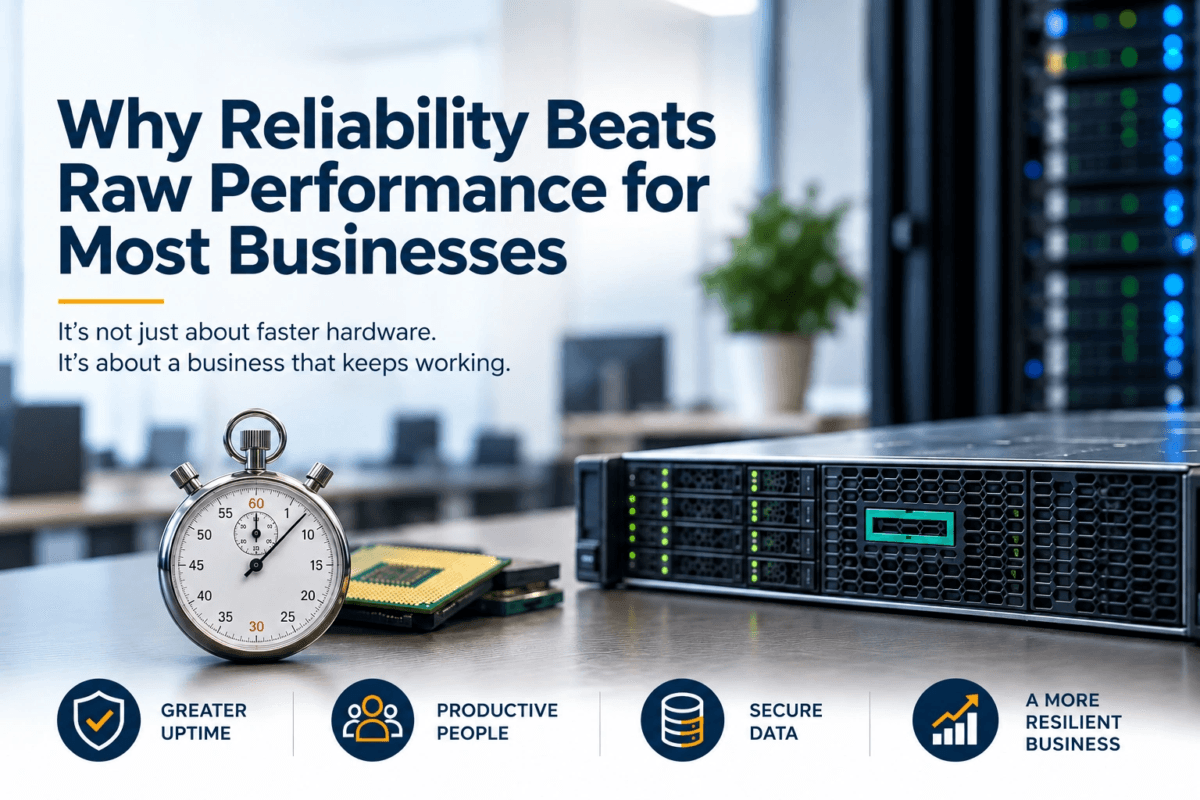
When businesses buy technology, it is easy to be drawn towards the biggest numbers.
A newer processor.
More cores.
Higher clock speeds.
The latest generation of server hardware.
The fastest SSDs money can buy.
Technology manufacturers are very good at selling performance. Every new generation promises to be faster, smarter, and more powerful than the last.
However, for most small businesses, raw performance is rarely the thing that determines whether their IT works well.
A business does not usually fail because a server takes 0.2 seconds longer to open a file or because a database query takes a fraction longer to complete.
Businesses suffer when systems are unreliable.
When emails stop working.
When files cannot be accessed.
When applications become unavailable.
When staff cannot work because the technology they depend on has failed.
For many small businesses, reliability, stability, and predictability are far more valuable than having the newest and fastest hardware.
The best IT system is not always the one that wins a benchmark test. It is the one that quietly works every day.
The Difference Between Performance and Reliability
Performance and reliability are often confused, but they are very different things.
Performance
Many small businesses overestimate how much computing power they actually need. A company with only a handful of employees may not require the latest generation server hardware to run everyday workloads such as file sharing, applications, virtual machines, and backups.
Understanding the right level of server performance is just as important as choosing reliable hardware. In our guide “How Much Server Performance Does a Small Business Really Need?”, we look at what small businesses should realistically expect from their server infrastructure.
Performance is about how quickly a system can complete a task.
Examples include:
- How quickly a server processes requests
- How fast a website loads
- How quickly a database responds
- How many virtual machines a host can run
- How many users a system can support
A high-performance server might have
- The latest Intel Xeon or AMD EPYC processors
- Large amounts of DDR5 memory
- NVMe storage
- High-speed networking
These specifications are impressive, but performance only matters when the business actually needs it.
Reliability
Reliability is about whether the system continues working when it is needed.
A reliable system provides:
- Consistent operation
- Fewer unexpected failures
- Predictable performance
- Better uptime
- Easier maintenance
- Longer service life
For a small business, reliability often matters more because there are fewer people available to deal with problems.
A company with hundreds of employees may have dedicated IT engineers monitoring systems around the clock.
A company with five or ten employees may have one person who “looks after the computers” alongside their normal job.
In this environment, technology needs to be dependable.
Why Newer Does Not Always Mean Better
Many businesses assume that buying the newest hardware automatically means buying better technology.
Sometimes it does.
However, enterprise technology is designed differently from consumer equipment.
Enterprise hardware is built around:
- Long operating lifetimes
- High availability
- Component redundancy
- Remote management
- Serviceability
- Business-critical workloads
A server from several years ago may still have features that are missing from a brand-new desktop or entry-level server.
For example, an older HPE ProLiant server may include:
- Dual redundant power supplies
- ECC memory
- Hot-swappable drives
- Hardware RAID controllers
- Remote management through HPE iLO
- Enterprise-grade cooling systems
- Support for multiple CPUs
These features were designed for businesses where downtime costs money.
Enterprise Hardware Is Built to Last
A good example is the HPE ProLiant DL380 server family.
A server such as an HPE DL380 Gen9 may not compete with a modern Gen11 server in raw benchmark performance.
However, it was designed for data centres and business environments.
A typical configuration might include:
- Dual Intel Xeon processors
- Hundreds of gigabytes of ECC RAM
- Multiple SAS storage drives
- Hardware RAID protection
- Redundant power supplies
- Remote administration
For many small businesses, this level of hardware is already more than enough.
A company running:
- File servers
- Active Directory
- Microsoft SQL databases
- Virtual machines
- Business applications
- Backup systems
may not need the latest generation equipment.
They need equipment that works reliably.
Why SAS Storage Can Still Beat Consumer SSDs
One area where specifications can sometimes be misleading is storage.
A consumer SSD may appear much faster than an enterprise SAS hard drive.
A modern NVMe SSD can achieve several gigabytes per second of throughput.
However, enterprise storage is not only about speed.
Enterprise SAS drives are designed for:
- 24/7 operation
- Heavy workloads
- High write endurance
- Predictable failure behaviour
- RAID environments
A 10K RPM SAS drive may look slow compared with an NVMe drive, but inside a properly configured RAID array it can still provide excellent performance for many business workloads.
For example:
A small business file server with:
- 8 to 16 SAS drives
- RAID protection
- Enterprise RAID controller
- Plenty of memory
can easily provide reliable storage performance for dozens of users.
The goal is not to win a benchmark.
The goal is ensuring employees can access their files every day.
Downtime Costs More Than Hardware
One of the biggest mistakes businesses make is focusing only on purchase price.
A faster server might save a user a few seconds every day.
A reliable server prevents hours or days of lost productivity.
Consider a small company with:
- 10 employees
- Average staff cost of £25 per hour
- Everyone unable to work for four hours
The downtime cost quickly becomes:
10 employees × £25 × 4 hours = £1,000
This does not include:
- Lost sales
- Customer impact
- Emergency IT support costs
- Reputation damage
A slightly older but reliable system can often provide a better business return than expensive new hardware.
Reliability Comes From the Whole System
A reliable IT environment is not just about the server.
It is a combination of:
Hardware Quality
Enterprise equipment provides:
- Better components
- Redundancy
- Monitoring
- Easier repairs
Storage Protection
A good storage design includes:
- RAID
- Monitoring
- Spare drives
- Backup systems
Remember:
RAID protects against hardware failure.
RAID is not a backup.
Good Software Design
Reliability also depends on:
- Regular updates
- Proper configuration
- Security practices
- Monitoring
- Documentation
Even the best hardware will fail if it is poorly configured.
Backup and Recovery
A reliable business system assumes something will eventually go wrong.
Good backup strategies include:
- Local backups
- Off-site copies
- Regular testing
- Recovery procedures
The question is not:
“Will something fail?”
The better question is:
“When it fails, how quickly can we recover?”
Virtualisation: Getting More From Reliable Hardware
Virtualisation has changed the way small businesses use servers.
Instead of running one application per physical server, a single reliable host can run multiple virtual machines.
For example, one enterprise server could run:
- Windows Server for Active Directory
- File services
- Business applications
- Linux web services
- Monitoring systems
- Backup management
Platforms such as:
- Proxmox VE
- VMware
- Microsoft Hyper-V
allow businesses to make better use of existing hardware.
A reliable server with enough resources can often run workloads that previously required multiple physical machines.
The Importance of Predictability
Small businesses need technology they can understand.
A predictable system means:
- Staff know it will work
- IT support knows how to maintain it
- Problems can be diagnosed quickly
- Costs are easier to manage
Constantly chasing the latest hardware can create unnecessary complexity.
Sometimes the best technology decision is not upgrading.
Sometimes it is maintaining a system that already does the job well.
When Raw Performance Does Matter
This does not mean performance is irrelevant.
Some businesses genuinely need the latest technology.
Examples include:
- Video production
- Engineering simulations
- Large databases
- AI workloads
- High-frequency trading systems
- Large-scale analytics
In these situations, performance directly affects revenue.
However, many small businesses are running workloads where reliability is the priority.
Email.
Files.
Accounts software.
CRM systems.
Line-of-business applications.
For these environments, stability wins.
A Practical Approach for Small Businesses
Before buying new hardware, businesses should ask:
What problem are we solving?
Are users actually complaining about speed?
Or are we simply attracted by new technology?
What happens if this system fails?
Do we have:
- Backups?
- Spare parts?
- A recovery plan?
- Documentation?
Are we buying features we need?
A server with twice the performance may provide no real benefit if the business only uses 20% of its current capacity.
Conclusion
For most small businesses, reliability beats raw performance.
The latest processor, fastest storage, and newest hardware are not automatically the best investment.
A well-designed, enterprise-grade system that operates consistently every day is often far more valuable.
Technology should support the business, not become another problem to manage.
A reliable IT environment allows employees to focus on their work, customers to receive a consistent service, and business owners to have confidence that their systems will keep running.
At SDN46, we believe enterprise technology does not have to mean buying the newest equipment.
Sometimes the smartest solution is proven hardware, configured correctly, maintained properly, and matched to what the business actually needs.
Enterprise technology, simplified for small business.
