Infrastructure & Cloud, Security & Business Continuity
How SafeLine WAF Can Protect Your Internet Presence and Applications
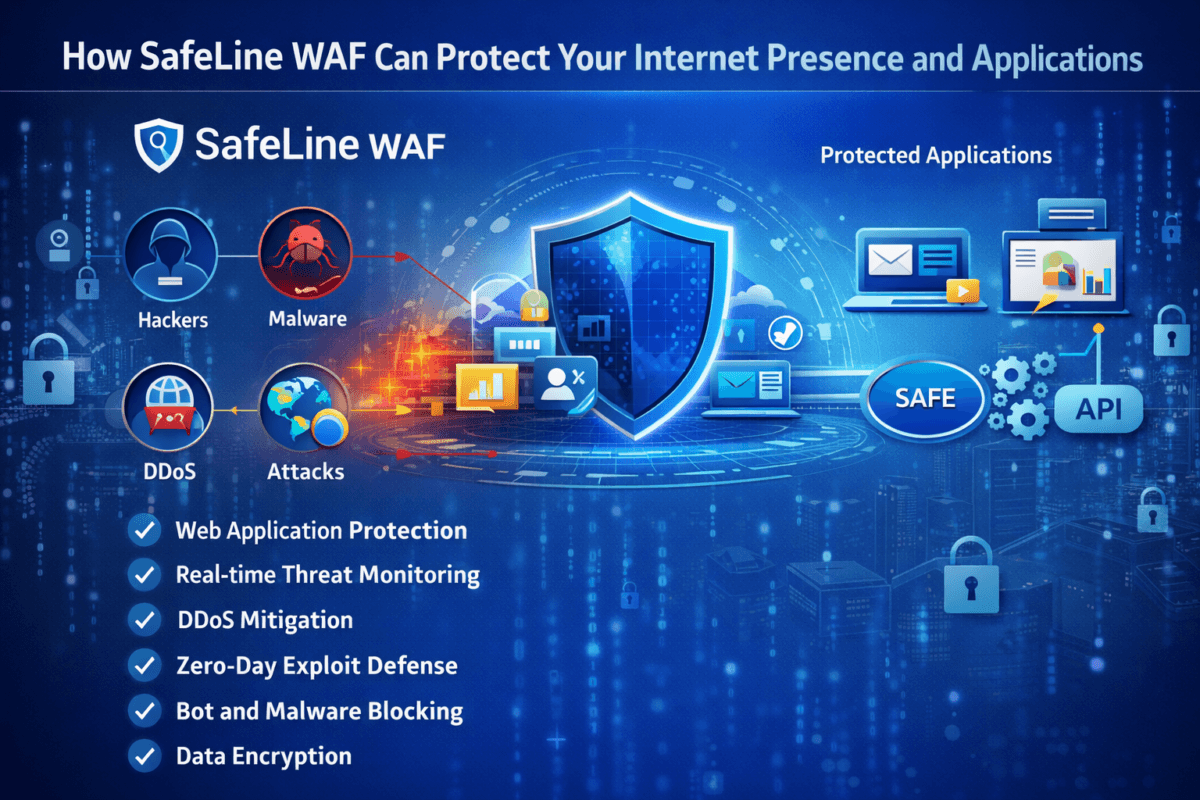
In today’s connected world, almost every business relies on the internet in some form. Whether it is a public-facing website, a customer portal, an API powering mobile applications, or internal web tools used by staff, these systems form the digital backbone of modern operations.
However, as quickly as businesses have embraced web-based technologies, cyber threats have evolved right alongside them. Attackers are no longer simply targeting infrastructure at random they are actively probing websites, applications, and APIs for weaknesses every single second of the day.
This is where a Web Application Firewall (WAF) becomes essential.
In this blog post, we’ll explore how a modern solution such as SafeLine WAF can help protect your internet-facing services and applications. We’ll break down what it does, how it works, why it matters, and how it fits into a broader cybersecurity strategy all in a way that is practical, approachable, and relevant to real-world environments.
Understanding the Problem: Why Web Applications Are Constantly Under Attack
To understand why a WAF is necessary, it helps to first understand what modern web applications are up against.
The moment a website or application is exposed to the internet, it becomes a target for automated scanning tools. These tools are constantly looking for:
- Weak login forms
- Outdated plugins or frameworks
- Misconfigured servers
- Injection vulnerabilities
- Exposed admin panels
- API endpoints without proper authentication
Importantly, these attacks are not personal they are automated. Bots continuously scan vast ranges of IP addresses, probing for anything that looks exploitable.
Even a small business website can receive thousands of malicious requests per day without its owner ever realising it.
Common attack types include:
SQL Injection, where attackers attempt to manipulate database queries to extract or modify sensitive data.
Cross-Site Scripting (XSS), where malicious scripts are injected into web pages and executed in users’ browsers.
Brute force login attempts, where automated systems try thousands of password combinations to gain access.
Bot traffic, which can be used for scraping, spamming forms, or probing for vulnerabilities.
Zero-day exploitation attempts, where attackers try known patterns against newly discovered vulnerabilities.
Without protection, even well-built applications can be exposed to unnecessary risk simply by being online.
What Is a Web Application Firewall (WAF)?
A Web Application Firewall acts as a protective layer between your users and your web applications.
Instead of allowing traffic to reach your application directly, a WAF intercepts requests first, inspects them, and decides whether they are safe or potentially malicious.
At a basic level, it works like a security checkpoint. Every request is examined before being allowed through.
A WAF can:
- Block malicious requests
- Filter suspicious traffic patterns
- Enforce security rules
- Protect against known exploit techniques
- Rate-limit abusive behaviour
- Log and monitor attack attempts
Unlike traditional firewalls, which focus on network-level traffic (such as IP addresses and ports), a WAF operates at the application layer. This means it understands HTTP/HTTPS traffic and can analyse the actual content of requests.
This is what makes it so powerful and so necessary in modern web environments.
Introducing SafeLine WAF
SafeLine WAF is a modern Web Application Firewall designed to protect web applications, APIs, and internet-facing services from a wide range of cyber threats.
It acts as a reverse proxy between users and your applications, filtering traffic before it ever reaches your backend systems. By doing so, it provides a critical layer of defence against both automated attacks and more targeted exploitation attempts.
What makes SafeLine WAF particularly relevant in today’s environment is its focus on practical, real-world protection. Rather than relying on a single detection method, it combines multiple techniques to identify and mitigate malicious behaviour.
At a high level, it is designed to help organisations of all sizes improve their security posture without needing an overly complex security stack.
How SafeLine WAF Protects Your Applications
To understand its value, it is helpful to look at how SafeLine WAF operates in practice.
When a user or bot sends a request to your application, the request does not go directly to your server. Instead, it is first routed through the WAF.
At this point, several things happen:
1. Traffic Inspection
Each request is analysed for suspicious patterns. This includes examining URLs, headers, cookies, and payloads. The WAF looks for known indicators of attack behaviour, such as injection attempts or abnormal request structures.
2. Rule-Based Filtering
Requests are evaluated against a set of security rules. These rules are designed to identify common attack vectors such as SQL injection, XSS attempts, and malicious payloads.
3. Behaviour Analysis
In addition to static rules, the system can identify unusual behaviour patterns. For example, repeated login attempts from the same source or unusually high request rates may indicate automated attacks.
4. Traffic Decisioning
Once analysis is complete, the request is either:
- Allowed through to the application
- Blocked entirely
- Challenged (for example, to verify it is not a bot)
5. Logging and Visibility
All activity is logged, giving administrators visibility into what is happening behind the scenes. This is particularly useful for identifying attack trends and tuning security policies over time.
Key Security Benefits of Using SafeLine WAF
A WAF is not just about blocking attacks—it is about building resilience into your web infrastructure.
Protection Against Common Web Attacks
One of the most immediate benefits is protection against widespread attack types such as SQL injection and XSS. These vulnerabilities remain some of the most commonly exploited issues in web applications today.
By filtering malicious payloads before they reach your application, SafeLine WAF significantly reduces exposure to these risks.
Defence Against Automated Bots
A large proportion of internet traffic is generated by bots. Some are legitimate, such as search engine crawlers, but many are malicious.
These bots may attempt to:
- Scrape sensitive data
- Brute-force login pages
- Probe for vulnerabilities
- Spam forms or APIs
SafeLine WAF helps distinguish between legitimate users and automated threats, allowing you to control or block unwanted activity.
Reduced Attack Surface
By filtering traffic at the edge, the WAF reduces the number of malicious requests that ever reach your application. This means your backend systems are not constantly being exposed to unnecessary load or risk.
In practical terms, this can also improve performance by reducing noise traffic.
Improved Visibility and Monitoring
Security is not just about blocking threats—it is also about understanding them.
SafeLine WAF provides visibility into:
- Attack attempts
- Traffic patterns
- Geographic sources of requests
- Frequency of malicious activity
This information is invaluable for both security teams and system administrators.
Layered Security Approach
A WAF does not replace other security measures—it complements them.
It works alongside:
- Firewalls
- Intrusion detection systems
- Secure authentication mechanisms
- Application-level security controls
This layered approach is essential in modern cybersecurity strategy.
Where SafeLine WAF Fits in a Modern Architecture
In a typical deployment, SafeLine WAF sits in front of your web applications as a reverse proxy.
This means all incoming traffic flows through it before reaching:
- Web servers
- Application servers
- APIs
- Backend services
This positioning is critical. By placing security at the entry point, you ensure that malicious traffic is filtered out as early as possible.
For cloud-based environments, it can also be deployed in front of containerised workloads, load balancers, or microservices architectures.
Practical Use Cases
SafeLine WAF is suitable for a wide range of environments, including:
Small Businesses
Protecting websites, customer portals, and booking systems from automated attacks.
E-commerce Platforms
Securing payment flows, customer data, and checkout processes from exploitation attempts.
SaaS Applications
Protecting APIs and multi-tenant platforms where security is critical to customer trust.
Homelabs and Learning Environments
Providing hands-on experience in understanding real-world web attacks and defence mechanisms.
Enterprise Environments
Adding an additional layer of protection in complex, distributed architectures.
Deployment Considerations
While WAFs are powerful, they do require thoughtful configuration.
Some key considerations include:
- Defining what “normal” traffic looks like for your application
- Avoiding overly aggressive rules that may block legitimate users
- Monitoring logs regularly to fine-tune detection
- Ensuring compatibility with existing infrastructure
A poorly configured WAF can lead to false positives, where legitimate users are mistakenly blocked. Proper tuning is therefore essential.
Limitations to Be Aware Of
Although SafeLine WAF provides strong protection, it is not a complete security solution on its own.
It cannot:
- Fix insecure application code
- Replace secure authentication systems
- Prevent internal breaches
- Eliminate all vulnerabilities automatically
Instead, it should be viewed as one component of a broader security strategy.
The most effective security posture always combines secure development practices, infrastructure hardening, monitoring, and layered defence.
Best Practices for Using a WAF Effectively
To get the most value from SafeLine WAF, organisations should:
- Start in monitoring mode before enforcing strict blocking rules, allowing time to understand normal traffic behaviour.
- Regularly review logs to identify emerging threats or unusual patterns.
- Gradually tighten rules as confidence in the configuration increases.
- Combine WAF protection with secure coding practices and regular patching.
- Treat the WAF as a living system that evolves alongside your application.
Final Thoughts
In an era where web applications are under constant automated attack, relying solely on traditional perimeter security is no longer enough.
A Web Application Firewall adds a crucial layer of protection by inspecting traffic at the application level and stopping threats before they reach your infrastructure.
SafeLine WAF represents a modern approach to this challenge, offering organisations a practical way to improve security visibility and reduce exposure to common web-based attacks.
For small businesses, it can be a straightforward way to strengthen defences without building an overly complex security stack. For larger environments, it serves as an important additional layer in a defence-in-depth strategy. And for home labs, it provides an excellent opportunity to learn how real-world application security works in practice.
It’s no longer a question of whether your web applications will be targeted, they already are.
The real question is simple:
Do you have anything standing between you and those attacks?
With a properly configured Web Application Firewall (WAF), the answer becomes
Yes your applications are protected.
